CRO Basics
How to Increase Mobile Conversion Rates in 2025
Dec 29, 2025

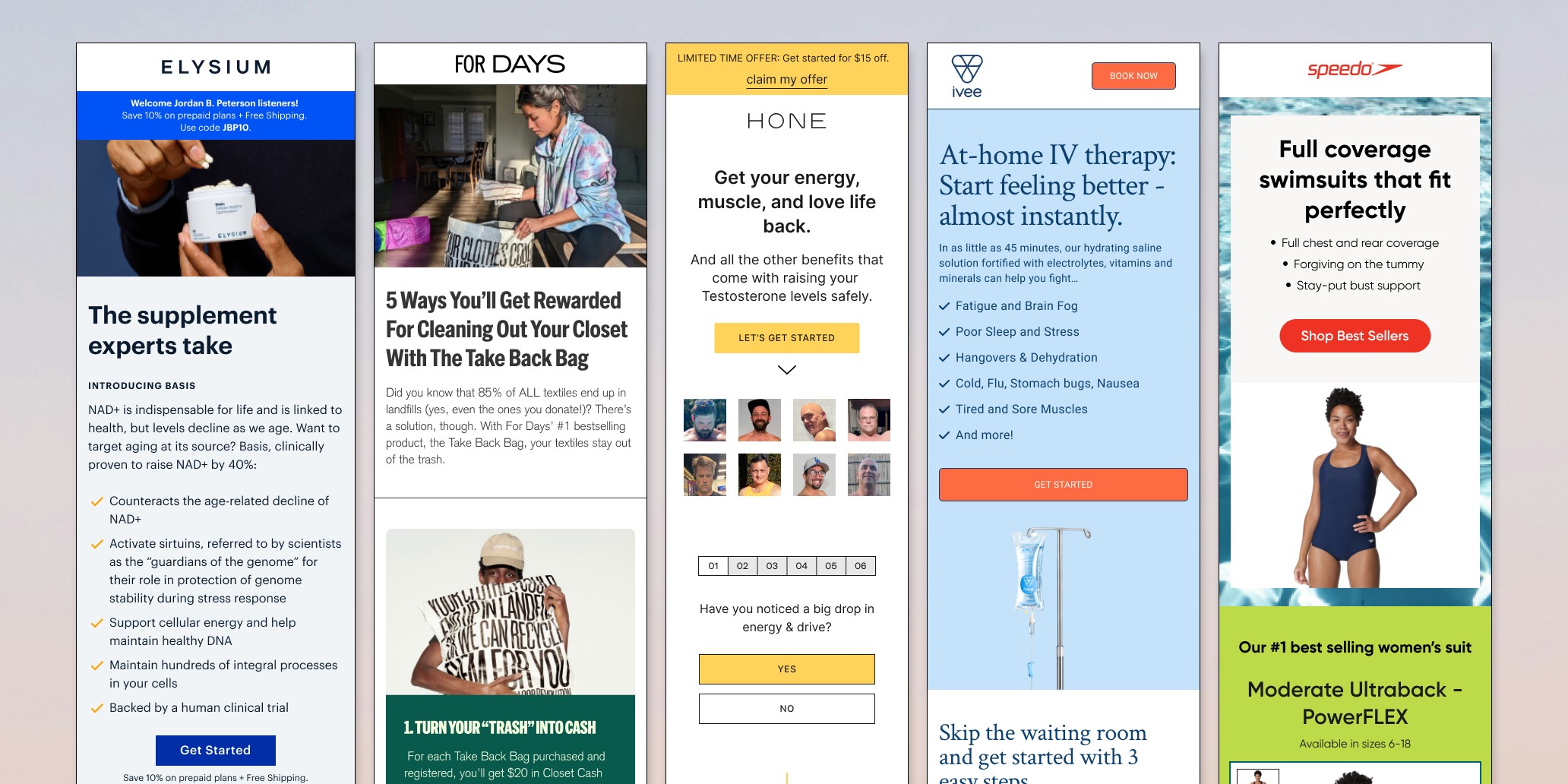
Mobile commerce now drives the majority of e-commerce traffic for most brands. In many industries, mobile devices account for more than 60% of landing page visits. Yet mobile conversion rates consistently lag behind desktop, often converting at roughly half the rate.
This gap represents a significant revenue opportunity. Improving mobile conversion rates allows brands to grow revenue without increasing ad spend or traffic volume.
This guide outlines the highest impact strategies to increase mobile conversion rates in 2025. These recommendations are grounded in current performance patterns, mobile user behavior, and conversion rate optimization principles that apply across e-commerce categories. If your overall conversion rate is underperforming, start with Why Your Landing Page Is Not Converting in 2025 to identify foundational friction before isolating mobile issues.
Why Mobile Conversion Rates Lag Behind Desktop
Mobile users behave differently from desktop users. They scroll faster, make quicker judgments, and have less tolerance for friction. Small delays or unclear interfaces lead to rapid abandonment.
Mobile conversion rates are commonly suppressed by:
Slow page load times on cellular networks
Complicated checkout flows
Small or poorly placed tap targets
Unclear value propositions
Navigation that requires excessive effort
Mobile optimization is not about shrinking a desktop site. It requires designing around one-handed use, limited attention, and the expectation of instant clarity.
The Seven Highest Impact Mobile CRO Strategies
1. Optimize Mobile Page Speed
Page speed is foundational to mobile conversion performance. Slower pages consistently produce higher bounce rates and lower conversion rates, especially on mobile networks with variable connectivity.
Research consistently shows that even small speed improvements can produce meaningful conversion gains.
How to improve mobile page speed:
Compress and properly size images before upload
Reduce unnecessary scripts and page elements
Enable browser caching
Use a content delivery network
Test speed under real mobile network conditions
Faster pages improve conversion rates, engagement, and search visibility simultaneously.
2. Simplify Mobile Checkout
Cart abandonment remains high across e-commerce, and mobile checkout friction is a primary driver.
Mobile checkout best practices:
Offer guest checkout
Reduce form fields to essentials only
Support Apple Pay, Google Pay, PayPal, and buy now pay later options
Show progress indicators
Display trust signals near payment entry
Checkout optimization often delivers the fastest revenue impact because it targets users with the highest purchase intent. For fast, low-risk experiments in this area, see The Simple CRO Tests That Increase Revenue Fast.
3. Design for Thumb Navigation
Mobile users navigate with thumbs, not cursors. Interfaces must accommodate one-handed use.
Thumb-friendly design principles:
Primary buttons at least 44px tall
Critical actions placed in the lower portion of the screen
Adequate spacing between tap targets
Sticky CTAs or navigation for key actions
Testing with real thumb usage often reveals friction analytics alone will miss.
4. Reduce Cognitive Load
Mobile screens limit how much information users can process at once. Clarity must come before completeness.
Ways to reduce cognitive load:
Short sections with clear headers
Concise paragraphs and white space
Visual emphasis on key points
Fewer simultaneous choices
Essential information above the fold
Mobile users make faster decisions. Pages must support that behavior. For a deeper breakdown of clarity driven conversion gains, reference How to Improve Landing Page Clarity Fast.
5. Optimize Product Filters and Search
Mobile navigation must balance speed and simplicity.
Effective mobile filtering strategies:
Limit filters to high-impact options
Use sticky filter access
Clearly display active filters
Favor broad categories over granular lists
Use progressive disclosure
Users should find relevant products within seconds.
6. Implement Mobile-Specific Trust Signals
Trust plays a critical role in mobile decision-making.
Mobile trust signals that improve conversion:
Reviews and ratings near product images
Clear return and shipping policies
Secure payment indicators
User-generated content
Social proof placed above the fold
Mobile users rely on trust cues quickly because decisions happen faster.
7. Personalize the Mobile Experience
Personalization reduces effort and speeds decision-making.
Mobile personalization strategies:
Product recommendations based on behavior
Messaging aligned to traffic source
Location or device-based adjustments
Personalized CTAs for returning users
Personalized experiences consistently outperform generic ones by helping users reach relevant outcomes faster.
Mobile Conversion Metrics That Matter
Key metrics to monitor:
Mobile vs desktop conversion rate
Add-to-cart rate
Mobile checkout abandonment
Mobile page load time
Scroll depth by device
Bounce rate by device
These metrics identify where optimization will deliver the highest return.
Common Mobile Conversion Mistakes
Forcing desktop layouts onto mobile
Small or crowded tap targets
Hiding critical information below the fold
Mandatory account creation
Overly complex navigation
Ignoring mobile speed performance
Multiple friction points compound abandonment rapidly.
How CARO Approaches Mobile Conversion Optimization
At CARO, mobile optimization is embedded within a broader CRO framework. Mobile performance is evaluated across speed, clarity, navigation, and checkout behavior rather than isolated tactics.
This approach prioritizes changes based on revenue impact and user hesitation points, creating measurable gains without unnecessary redesigns.
What to Do Next
If mobile traffic is strong but conversions lag, start with:
Mobile page speed
Checkout flow
Navigation clarity
These areas consistently produce the fastest conversion lifts when addressed systematically.
Frequently Asked Questions
What is a good mobile conversion rate in 2025?
For e-commerce, mobile conversion rates commonly range from 2 to 3%. Top-performing mobile experiences often exceed 4%, depending on industry and traffic quality.
Why are mobile conversion rates lower than desktop?
Smaller screens, touch navigation, network variability, and on-the-go browsing increase friction on mobile.
How long does it take to improve mobile conversion rates?
Most improvements show measurable impact within two to four weeks, depending on traffic volume.
Should I build a mobile app or optimize my mobile site?
For most brands, optimizing the mobile website delivers higher ROI. Progressive web apps can improve performance in some cases, but are not universally necessary.
What should I prioritize first?
Focus on reducing the gap between mobile and desktop conversion rates rather than targeting an arbitrary benchmark.